The transition to green shipping
An holistic approach to a global problem
IMO's plan to cut GHG by 50 % means emissions must be considered in a well-to-wake cyclical perspective. Cleaning heavy fuel oil operation and reserving E-fuels for other purposes is part of the holistic solution that Solvang pursues.
1: Choosing the fuel for sustainability →
The only energy sources which can potentially reduce CO2 emissions in a lifecycle perspective, are biofuels and E-fuel. Those fuels are currently not available to deep-sea shipping. Making HFO (heavy fuel oil) with exhaust cleaning and carbon capture the best possible fuel for sustainability. Read more
3: How we minimize emissions →
In accordance with the well-to-wake principle, Solvang built a framework to control all instances of emission from our shipping operations. As a result, we have reduced SOx emissions by 99.8 %, NOx by 80+ %, and heavy metals and other pollutants with 80-100 %. Currently, we cut CO2 in Solvang's onboard carbon capture programme. Read more
1. HFO as energy source
HFO in a well-to-wake perspective
Shipping should measure greenhouse gas (GHG) emissions in a well-to-wake (WTW) perspective. By counting all emissions from production of fuel to propulsion delivered. The WTW comparison shows technology makes a bigger difference than changing to alternative fuels.
Since the 0.5 percent sulphur limit was introduced in 2020, all vessels without exhaust gas cleaning (SOx scrubbers) had to change to VLSFO (very low sulphur fuel oil) i order to operate in deep sea markets.
This is heavy fuel oil
HFO is not dirty in proper combustion conditions, in combination with scrubber. HFO has excellent energy properties, and is the main preference for bunker world-wide. HFO is a residual fuel, consisting of crude oil compounds, containing sulphur plus traces of metal from organic material (algae and zoo plant).
HFO burns clean and emits an amount of NOx, unburnt hydrocarbons (THC) and CO similar to low-sulphur diesel oil. Sulphur contents make particle levels in g/kWh higher, though.
In comparison, Solvang's two-stroke slow speed engines emit less smoke from HFO than four-stroke medium speed engines on alternative conventional fuels. Smoke particles are further deemed at lower hazard to humans than MGO exhaust particles.
Read more: Years of evolution has made HFO fuelled shipping greener
The well-to-wake case
In a "well-to-wake" perspective, considering all emissions throughout the lifecycle of an energy source, the only fuels which can potentially reduce CO2 emissions significantly, are biofuels and E-fuel. As these options are currently not available to deep-sea shipping, HFO improves its position as the best possible route to sustainability.
Groups of future fuel categories
| HFO, VLSFO, MGO, LNG and LPG | Conventional fossil fuels |
| Biofuels | |
| Hydrogen and ammonia | Conventional and E-fuels |
| Synthetic E-fuels | Gaseous or liquid fuels produced from hydrogen and carbon captured by using renewable electricity |
| Battery power | Electric power from batteries charged from the grid |
Carbon emissions from different shipping fuels
The figures below compare GHG impact short-term and long-term. The charts consider varios fuel types from well-to-wake (WTW). Remarkably, heavy fuel oil (HFO) with scrubber reduces GHG emmissions 4-6 percent compared to VLSFO.
Short term 20 years

Long term 100 years

Biofuels
Biofuel may replace conventional fossil fuels with only minor modifications to the engine and fuels systems.
When assessing the emissions from well-to-wake, fuel from a clean biological source may reduce green house gas emissions by 75-80 % compared to marine gas oil (MGO). However this requires correct use of engine technology and clean sourcing.
The figure below shows how crucial the well-to-wake approach is when assessing the total GHG emissions. For example, biofuel from palm oil may increase the overall GHG emissions with up 200-300 %.

Hydrogen and ammonia (conventional and E-fuels)
Synthetic E-fuels (gaseous or liquid fuels produced from hydrogen and carbon captured by using renewable electricity)
The present IMO carbon factor is based on a Tank To Wake priciple, not Well To Wake. Thus the fuel source and how it is produced does not matter.
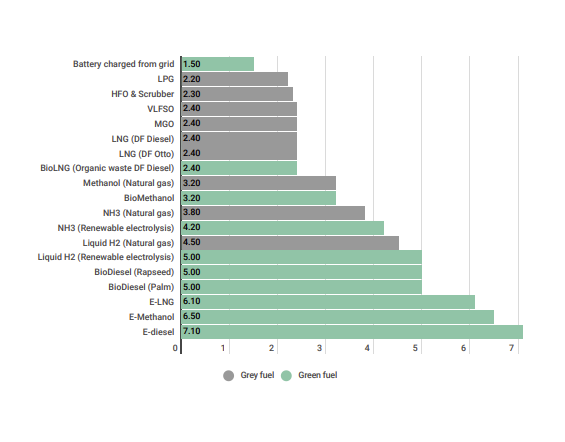
E-type fuels has zero emissions in the figure. This requires fuel production from a renewable energy source.

Energy needs for fuel production
Producing alternative fuels requires a colossal amount of energy. Where does the energy to produce fuel come from? We have to look at the source of the fuel for a complete picture. The figure below illustrates how much energy is required to produce power to the propeller.

FAQs about heavy fuel oil
2. How we use the fuel
Fuel consumption development for solvang's vessels
Since Solvang started regular measurements of emissions from our vessels in 1978, all have been reduced significantly. The cuts are all based on concrete steps with technological innovation and operational efficiency. We made no shortcuts and still don't - paving the way for a zero-emission operation.
Fuel consumption and emissions from 4 generations of ethylene carriers
Read more: Cutting edge research in Smart Maritime´s work package Power systems and fuel
Energy Efficiency Operational Index since 2009
Emission reduction by part-load optimization
THE WPLO PROJECT: Wärtsilä 2-stroke Part Load Optimization solution combines turbocharger modifications and engine tuning to shift the optimal load to a lower range. The test project was carried out onboard one of Solvang’s H-Class vessels, jointly by turbocharger specialist Accelleron and engine tuner Wärtsilä.
WPLO is a straightforward solution, which enhances engine performance during low load operations (30-75 percent), even if this compromises operation at high loads (85+ percent). The solution can be retro-fitted to vessels built before 2016 without dry docking. The installation on one of Solvang’s H-Class vessels yielded fuel savings of 3-4 percent on the engine, while combined fuel savings reached 25 percent. As a result, the vessel’s CII rating improved from D to A, and the vessel was able to maintain market speeds while staying EEXI compliant shortly after WPLO installation.

Hull optimization
More efficient hulls
Heat recovery
Waste-heat represents 50 percent of the system energy losses in shipping, thus representing a colossal potential for energy recovery. Solvang's ECO LPG carriers have waste-heat recovery systems (WHRS) generating useful heat from both main and auxiliary engines. All the vessels´ drinking water is produced from engine cooling water. Heat recovery on auxiliary engines minimize the need for boiler and can save 1-2 tonnes of fuel per day during port stay.
The Mewis Ducts: 7-10 percent carbon cut
Over many years, Solvang made investments in the Mewis duct programme. In collaboration with Becker Marine Systems, Clipper Posh and Clipper Quito became the first VLGCs in the world to feature Mewis Ducts back in 2013. The solution comprises a duct positioned in front of the propeller along with an integrated fin system. By straightening and accelerating the hull wake into the propeller and also producing a net forward thrust, the Mewis Duct saves up to 7 percent of fuel in the tank segment. In the case of Solvang’s fleet, annual savings will reach 10,000 tonnes of fuel or 30,000 tonnes of CO2 when all vessels have Mewis Ducts.
Propulsion drivetrain innovation
In collaboration with MAN, EcoBulbs have been installed on several vessels. MAN Enery Solutions also delivered Solvang’s propulsion drivetrain optimization programme, which was initiated in 2022. This substantial procedure includes propeller blades, a propeller-hub fairing cone and rudder-bulb integration, all together meeting EEXI and CII regulations via main-engine power optimization and increase of propulsive efficiency. According to Michael Muff Jensen with MAN Energy Solutions, the Solvang collaboration project “is spot on in terms of performance, efficiency and reduced CO2 emissions. This is just Solvang’s latest investment in its current fleet, confirming its position in the market as a committed front-runner in the efficient and environmentally-friendly transport of LPG and petrochemical gases.”
Anti-fouling technology
Operations performance tools
Solvang utilizes digital performance optimization tools to boost fuel efficiency and engine health. The Tekomar XPERT marine application from Accelleron allows us to control propulsion efficiency in parallel with current emissions. The digital tool collects extensive data from across our fleet, allowing for cross-vessel learning and optimization.
Learn more about our marine engine tool
In addition to digital performance optimization and surveillance, Solvang continuously collects engine vibration data in combination with tools for visualisation, animation, analysis and documentation of engine movement. We use SKF tools for vibration analysis and diagnostics.
For optimization of lifespan management for our systems and components, Solvang uses Star PMS (planned maintenance system) and EAM (enterprise asset management system).

3. How we clean the exhaust
Content
The total emission control system
Solvang runs a low-pressure exhaust gas recirculation system for NOx-TIR III control on main engines, combined with an exhaust gas cleaner (EGC/scrubber), in order to convert the sulphur in the fuel into sea salt. We use a hybrid exhaust gas cleaning system with electrostatic particle filters (WESP) for SOx and particle control onboard 12 vessels.
A pioneer of OCCS - onboard carbon capture
In 2023, Solvang received a grant of MNOK 80 from the Norwegian Climate and Energy Fund, in order to apply OCCS in operation. At the turn of the year, OCCS was being installed onboard the LPG carrier Clipper Eris. The system captures CO2 from the 7 MW main engine, before it passes through the exhaust outlets. Inside the smokestack, carbon gas is being separated, then refrigerated into liquefaction and transferred to deck storage. The installation is set to capture 70-80 percent of carbon dioxide from the main engine and auxiliary engines’ outlet, dramatically improving the ship’s environmental performance.

Solvang's EGC and low-pressure EGR setup
Solvang commenced its low-pressure EGR project with former gas tanker Clipper Harald in 2015, which showed continous HFO operation below NOx TIR III levels, without the use of urea. In 2019, the setup was extended to four 21,000 cbm ethylene carriers and one 80,000 cbm gas tanker.
The concept has been further developed to cover seven VLGC newbuildings scheduled for delivery from 2026.
The figure below shows an historical fuel burning reduction of 60 percent, NOx and particles reduction of 90 percent, and SOx reduction of 99.8 percent, respectively.

Scrubber pro's
- CO2: Reduced "well-to-wake”
- SOx: Reduced to LNG level
- High-value energy from low-cost residual oil
- Engines already fit for HFO
- Makes cheap fuel pay for NOx cleaning with LP-EGR
- Catches toxic particles in addition to MGO particles
- Prepares for ECO-EGR, TIR II NOx operation with EGR
Scrubber con's
- High investment costs
- Nickel and vanadium accumulation in enclosed harbours
Converting sulfur to sea salt
Solvang utilises calsium carbonate in a seawater scrubber to convert sulphur oxides into sea salt. The sea water flue-gas desulfurisation process (SWFGD) exceeds 98 percent in efficiency, and it yields no by-products. The flipside is a 2-3 percent rise in fuel (HFO) consumption, increasing CO2 emissions correspondingly. The alternative, to crack HFO in an onshore refinery, would increase CO2 emissions by 10-15 percent.
Alstom Sea Water Flue-Gas Desulfurisation process
Sea water salt content
The current natural concentration of calcium sulfate in seawater is 2.7 g/l. If all vessels in the world use fuel oil with scrubber for another 150 years, the concentration of calcium sulfate will rise to approximately 2.701 g/l.This means a seawater scrubber can be regarded as a reactor converting sulfur into sea salt.
Washwater management and samples
Solvang closely monitors the level of risk posed to humans and nature by our operations. The washwater from exhaust cleaning is analyzed according to PEC/PNEC and Norwegian criteria for metals, PAH components, hydrocarbons, nitrate/nitrite, turbidity and PH, in total 41 components plus PH and turbidity for each sample.
Solvang samples inlet sea water and outlet washwater from the EGC. The method follows IMO guidelines for the vessels' IAPP certifcates, and the results show similar figures for the predicted effect (PEC) and no-effect concentration (PNEC). Which indicated that washwater discharges do not affect the surrounding water at this distance or likely anywhere beyond. See Marintek report MT2016 F-152 ("Clipper Harald operation with scrubber").
Download data sheet for verified samples and analyses from 13 vessels, data series 2020-2024
For more information on specific samples and values, Solvang refers to IMO submissions (download pdf):
Metals
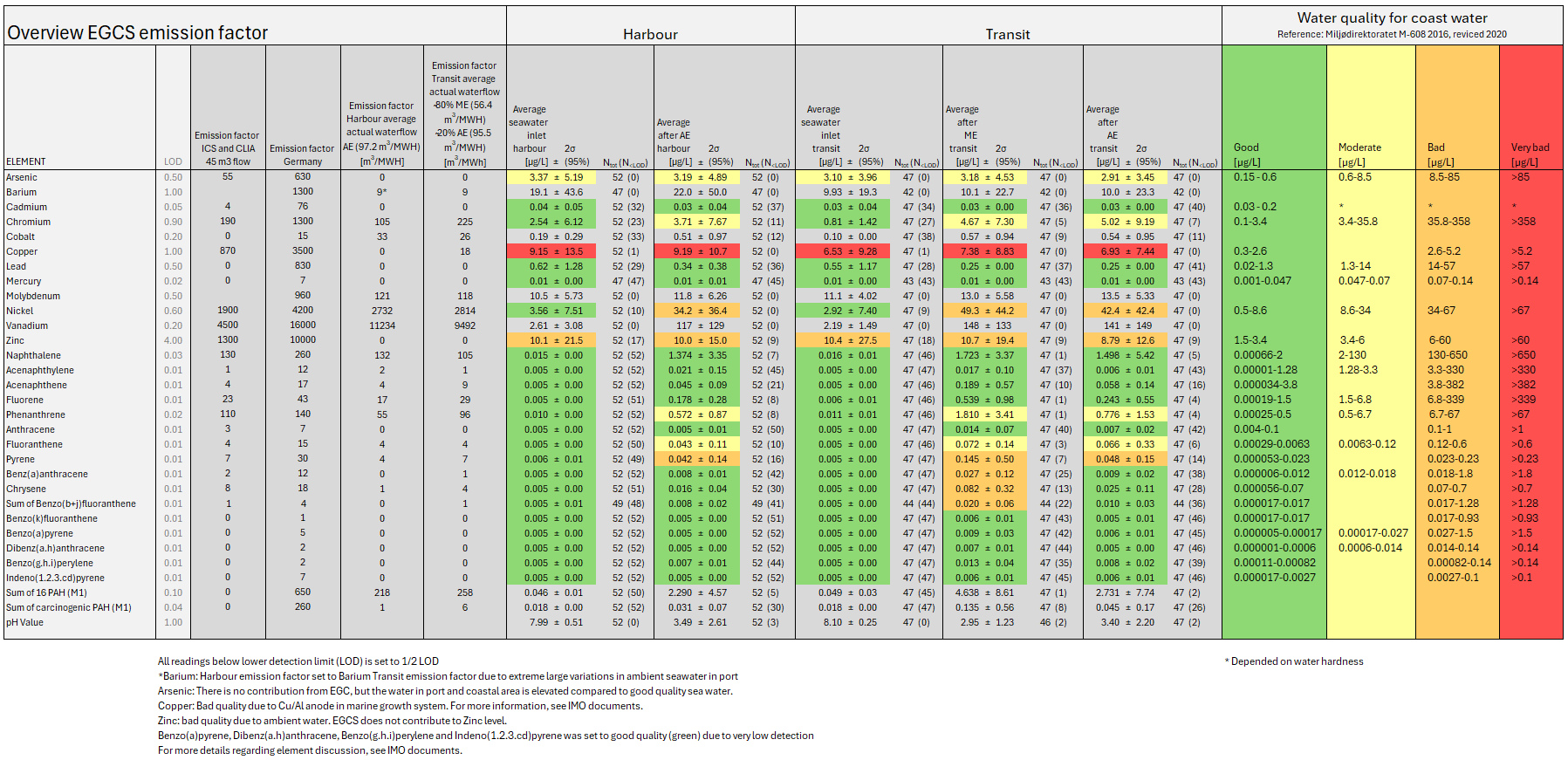
Solvang measures the content for several metals in EGC washwater sampling, among these arsenics, barium, cadmium, chromium, cobalt, copper, lead, mercury, molybden, nickel, vanadium, and zink.
Nickel (Ni) and vanadium (V) are the most abundant trace metals in ship exhaust burning HFO. Ni and V are toxic when concentrated, but antropogenic emissions are not likely to increase sea water concentrations by more than ~ 0.1-0.4 percent over one hundred years (V), or ~0.05 percent for Ni.
According to some studies, air emissions of Ni and V from HFO operation might impact concentrations in coastal areas. Whether hazardous to humans, animals or plants under such conditions, is being disputed.
PAH analysis: Polycyclic aromatic hydrocarbons
As part of the unburnt fuel (THC) in exhaust, PAH is being condensed in the scrubber and contained in sea water instead of discharging to the atmosphere. Well-maintained diesel engines running on HFO or MGO emit 0.1-0.2 g/kWh - about half the value of dual-fuel engines. Shipping is estimated to contribute 0.5 percent of the the total PAH emissions in Norway (last numbers from 2015).
Solvang's washwater analyses show less than 10 percent of the maximum ∆PAH levels. PAH carceniogenics are close to or below detection levels.
Read more:
Exhaust gas scrubber washwater effluent | US Environmental Protection Agency
Polysykliske aromatiske hydrokarboner (PAH) | Miljøstatus (NO-2018)
Automotive PAH emissions | Concawe. Environmental science for european refining
Polycyclic Aromatic Hydrocarbons (PAHs) | US Environmental Protection Agency
Polycyclic Aromatic Hydrocarbons | European Commission
Turbidity and Water | USGS.gov
Marintek report MT2016 F-152 ("Clipper Harald operation with scrubber")
WESP - the wet electrostatic filter
The Wet Electrostatic Precipitator (WESP) solution leads the exhaust from the main engine outlet through a honeycomb structure rigged with high voltage electrodes. The ensuing electrical field is able to filter up to 80 to 95 percent of particulate matter (PM), which is attached to the tube electrodes and flushed by water for cleaning onboard. According to WESP manufacturer Wärtsilä, the technology is incremental to Solvang's onboard carbon capture and storage (OCCS) technology.

Watch the WESP in action (remember to activate sound)
GHG reduction for different shipping fuels
The figure below illustrates the cost of reducing the emission of one ton GHG gas.
The calculation strongly support our work for making HFO clean. It is a very cost effective solution to reduce the GHG emissions. Actually it is the only available technology with a negative abatement cost. I.e. reduce cost and GHG emissions at the same time.
Well-to-wake emissions from different fuels

Total energy input WTW/delivered propulsion energy